
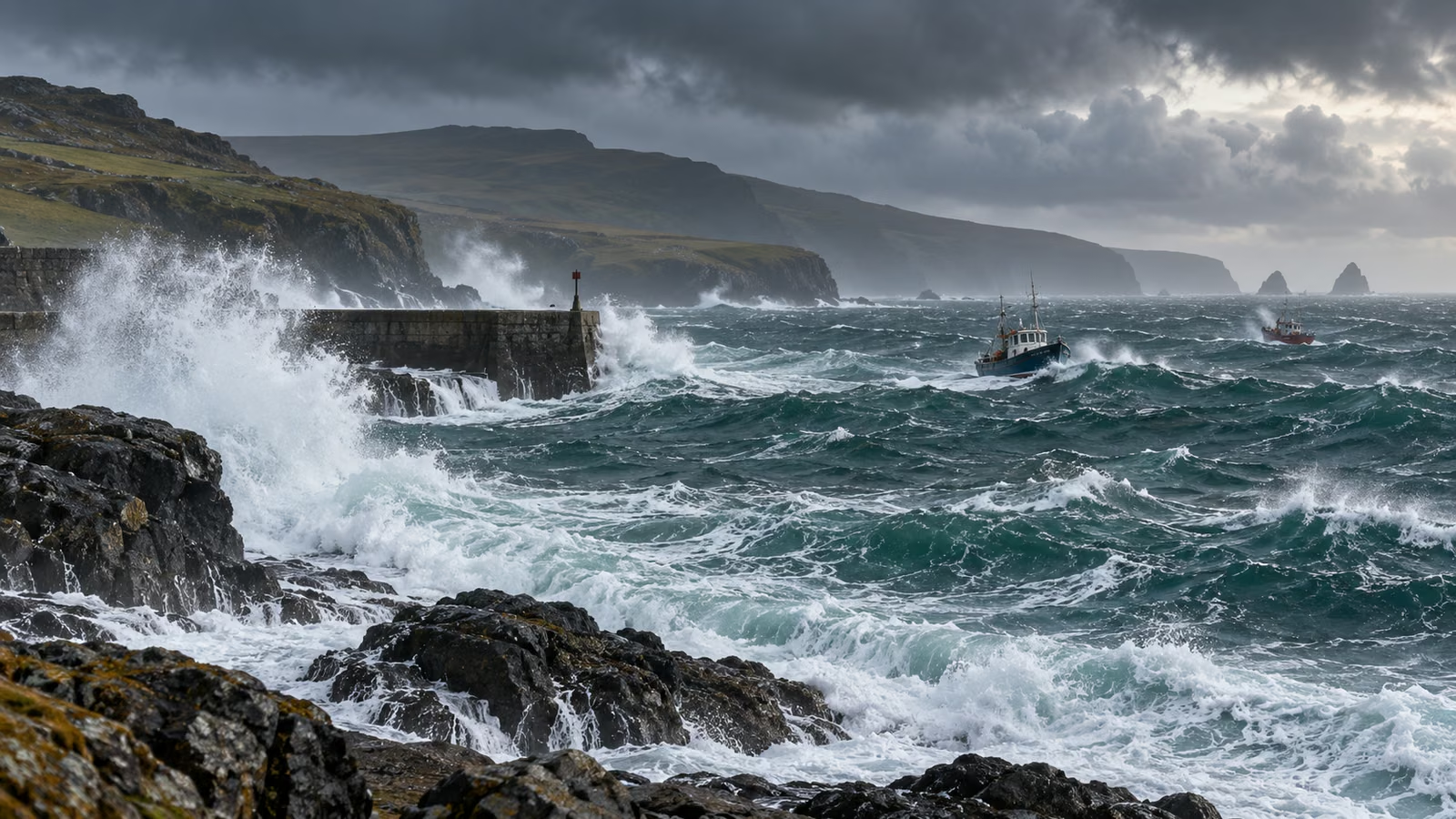
Met Éireann has a Status Yellow small-craft warning in force for part of Ireland’s Atlantic and northern coastline, with southwest winds expected to reach Force 6 or higher. The warning covers the coast from Loop Head to Rossan Point to Fair Head and is valid from Sunday evening, 4 October, until 11am on Monday, 5 October.
There is no general land weather warning in operation in the same bulletin. That distinction matters. Conditions can be relatively manageable on land while seas remain hazardous for small boats, kayaks and exposed coastal activities.
Where does the warning apply?
The named coastal sector runs from Loop Head on the west coast northward to Rossan Point and around to Fair Head. It therefore concerns a broad stretch of western and northern marine waters rather than every Irish coast.
Anyone planning a trip should check the latest Met Éireann marine map because warning boundaries can be updated. A national summary is useful, but the exact route and departure point determine the practical risk.
What does Force 6 mean?
Force 6 on the Beaufort scale is described as a strong breeze. At sea it can produce larger waves, extensive white foam and conditions that are uncomfortable or unsafe for many small craft.
The number alone does not tell the whole story. Wave direction, tide, fetch, harbour exposure and local headlands can make one area much rougher than another. Gusts can also be stronger than the sustained wind.
Why is a small-craft warning different from a land warning?
Marine warnings are designed for people operating on or near the sea. A wind speed that is inconvenient on land can create much more serious consequences on open water because a small vessel is exposed to waves and has limited shelter.
That is why a green land-warning status does not mean conditions are safe offshore. Boaters should use the marine forecast rather than relying on a phone weather icon for the nearest town.
Should recreational boats go out?
The decision depends on vessel type, crew experience, sea area and local conditions. A yellow warning is not a universal legal ban. It is a signal that conditions are more demanding and that vulnerable craft should exercise caution.
For an inexperienced crew in a small open boat, postponing may be the sensible choice. Experienced commercial operators may have different operating limits, but they still need to assess forecast wind, wave state and return conditions.
What about kayaks, paddleboards and small inflatables?
These craft are especially sensitive to wind. A strong offshore or cross-shore wind can move a paddler away from safety faster than expected. Turning back against Force 6 conditions can become extremely difficult.
Inflatables are particularly unsuitable in strong winds because they have large windage and limited control. A coastal forecast that looks merely «windy» from land can be dangerous once someone is on the water.
Why are headlands and channels risky?
Wind can accelerate around headlands and through narrow channels. Tidal streams can also oppose the wind, producing steeper and shorter waves. This can make a small area rougher than the general forecast suggests.
Local knowledge matters. A harbour that is sheltered in one wind direction may be exposed in another. People unfamiliar with an area should be particularly conservative when a warning is active.
What should coastal walkers know?
A small-craft warning is not automatically a hiking warning, but strong winds and large Atlantic swell can still affect cliff paths, piers and exposed promenades. Waves can overtop sea walls even when the sky is not producing severe rain.
Keep away from the edge of piers and rocks where breaking waves are reaching. Do not approach the water simply to photograph rough seas. Sudden larger waves can travel farther than the previous set.
How long is the warning valid?
Met Éireann states that the warning is valid until 11am Monday, 5 October. The service can extend, shorten or replace warnings as conditions change.
That means anyone travelling later in the day should not assume the original expiry time guarantees calm weather. Check the latest bulletin immediately before departure.
What equipment should boaters check?
Lifejackets or personal flotation devices should be worn and correctly fitted. Communication equipment should be charged and protected from water. Engines, fuel, bilge systems, navigation lights and anchoring equipment should be checked before leaving harbour.
A shore contact should know the route and expected return time. These are sensible precautions in ordinary conditions and become more important during a marine warning.
When should a trip be cancelled?
Cancel if the expected conditions exceed the limits of the boat, the crew or the route. The decision should be made before departure, not after conditions become uncomfortable offshore.
Fatigue also matters. A crew that can technically handle strong wind for a short period may not be able to do so safely for several hours, particularly in cold spray and rough seas.
What if someone is already at sea?
Follow the latest marine forecast and local Coast Guard guidance. If conditions deteriorate beyond what the vessel can safely handle, seek shelter or return to a safe harbour while it is still possible to do so without rushing.
In an emergency, call 112 or 999 and ask for the Coast Guard. Do not delay an emergency call because you are unsure whether the situation is serious enough.
Quick safety checklist
- Check the current Met Éireann marine warning immediately before departure.
- Understand whether the warning covers your exact coastal sector.
- Assess wind direction as well as wind speed.
- Wear a suitable lifejacket or PFD.
- Carry reliable communication equipment.
- Tell someone ashore your route and return time.
- Do not use small inflatables in strong offshore winds.
- Call 112 or 999 for the Coast Guard in an emergency.
Is there a wider severe-weather warning?
At the time of the bulletin, Met Éireann listed no general weather warning and no environmental advisory. The active item was the marine small-craft warning. That is useful context because it prevents overstating the situation.
The correct message is therefore targeted: coastal and marine users on the affected western and northern sector should take care, while the warning does not imply a nationwide land emergency.
Sources
The current details come from Met Éireann’s official warnings page, which lists the Status Yellow small-craft warning, the affected coastal stretch and the validity period.
More Ireland travel and practical safety coverage is available in Travel.