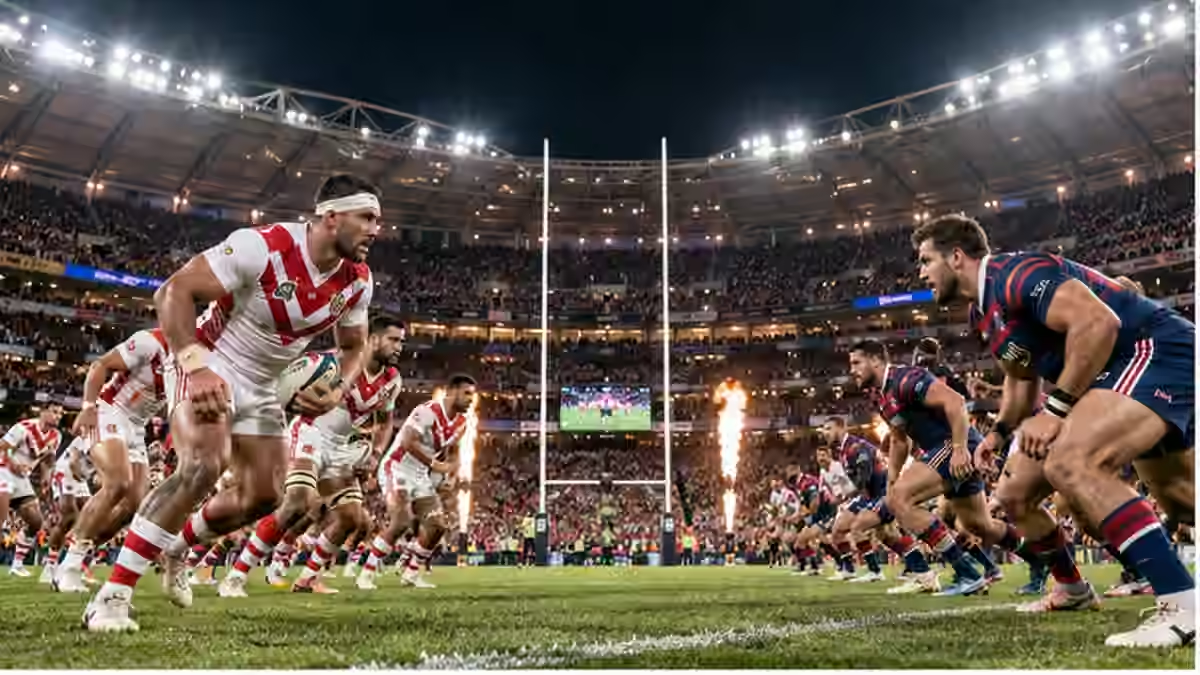
The Sydney Roosters are 2026 NRL premiers after surviving a dramatic Newcastle comeback to beat the Knights 19–18 at Accor Stadium. Newcastle led 12–0 early and threatened to complete one of the most remarkable last-to-first turnarounds in league history, but the Roosters changed the match before half-time, built a seven-point cushion in the second half and then held on as the Knights scored late to create a one-point finish.
Mark Nawaqanitawase was central to the comeback, scoring twice in his final appearance for the Roosters before returning to rugby union. Billy Smith added another crucial try, Sam Walker supplied points with the boot, and Daly Cherry-Evans — playing his final NRL game — kicked a field goal that ultimately became the difference between the teams.
How did the 2026 NRL Grand Final finish?
The final score was Sydney Roosters 19, Newcastle Knights 18. The crowd at Stadium Australia was 80,814, according to Reuters. The Roosters secured their 16th premiership and their first title since 2019, while Newcastle came within one point of completing a season that had already defied expectations after the club finished at the bottom the previous year.
The one-point margin is important because it changes how the field goal should be understood. Cherry-Evans' one-pointer did not look decisive when it was kicked, but once Newcastle crossed late and converted, that single point separated a Roosters premiership from the possibility of extra time or a different ending.
How did Newcastle build the 12–0 lead?
The Knights started with the greater scoreboard impact. Francis Manuleleua and captain Kalyn Ponga helped Newcastle establish a 12–0 advantage, giving the large Knights following a genuine sense that the fairytale run might continue all the way to a premiership.
That lead also changed the tactical pressure on Sydney. The Roosters could no longer simply wait for the match to settle. They needed to improve their completion, find better field position and create points before the deficit became large enough for Newcastle to control the tempo and kick long into the corners.
Why was Nawaqanitawase's first try a turning point?
Nawaqanitawase scored shortly before half-time, reducing Newcastle's advantage and giving the Roosters a different conversation to have in the sheds. A 12–0 deficit at the break would have left the Knights two converted tries clear. Scoring before half-time changed the emotional and tactical shape of the contest.
It also reinforced one of the pre-match statistical warnings for Newcastle. Nawaqanitawase had entered the decider with five tries in his previous three games. His size, finishing ability and comfort in high-pressure attacking situations made him an obvious danger near the line, and Newcastle could not keep him quiet for the full 80 minutes.
What changed after half-time?
The Roosters became more effective at turning possession into points. Billy Smith's contribution helped Sydney move from chasing the game to controlling the scoreboard. Once the Roosters were in front, Newcastle had to take more risks and play with greater urgency.
That did not mean the match was comfortable. Grand finals often become less about total metres or possession percentages and more about a handful of decisions: which side wins a contest in the air, who reacts first to a loose ball, whether a defensive line stays connected after repeated pressure and whether a kicker converts a difficult chance.
Why did Daly Cherry-Evans' field goal matter so much?
Cherry-Evans was already playing a historically significant match. At 37 years and 183 days, the NRL said he would become the oldest player in grand final history. It was also his final NRL appearance before his move to Hull FC.
The field goal gave Sydney a seven-point advantage at a stage when a converted try alone could no longer level the scores. Newcastle later scored through Greg Marzhew and converted, but the field goal meant the Knights were still one point short. It was a classic example of why experienced halves take one point when the match situation makes it valuable rather than waiting only for a try.
How close did Newcastle come at the end?
Very close. The Knights refused to disappear after the Roosters established their lead. Marzhew's late converted try turned the finish into a one-scoreboard-possession contest and forced Sydney to manage the closing moments with almost no margin for error.
For Newcastle, the late surge will make the defeat more painful because the comeback was alive until the closing stages. At the same time, it underlines how far the team travelled during the season. The Knights entered the grand final trying to become the first side since Western Suburbs in 1934 to go from last to first.
What made the Roosters' comeback possible?
It was not one isolated play. Sydney needed a series of corrections after falling 12 points behind: better control of the ball, more productive field position, patience near the Newcastle line and enough defensive resilience to stop the Knights from immediately answering every Roosters score.
The Roosters also carried more grand-final experience. Before kick-off, Newcastle had only one player with previous grand-final experience, Dane Gagai. Sydney had several players accustomed to high-level finals and a coach in Trent Robinson who had already won premierships. Experience does not guarantee a result, but it can help a team avoid panic when an early deficit develops.
What did the result mean for Trent Robinson?
Robinson added another premiership to his record and guided the club to its first title since 2019. The context matters because this was not a wire-to-wire final. Sydney had to respond to Newcastle's early control and then withstand a late rally.
For a coach, those two phases test different qualities. The comeback requires tactical adjustment and belief. The finish requires game management, discipline and communication when every carry and every tackle can decide the title.
Why is the result especially significant for Nawaqanitawase?
Because it was his final Roosters appearance before returning to rugby union. He leaves rugby league with a premiership and with two tries in the grand final, a rare way to close a chapter of a career.
His performance also demonstrates why cross-code athletes can create unusual match-ups. A winger with elite aerial ability, speed and physical size can force defenders to make difficult decisions close to the sideline and on attacking kicks. Newcastle had moments of strong edge defence, but Nawaqanitawase still found the scoreboard twice.
What should Newcastle take from the loss?
The obvious emotion is disappointment, but the broader season cannot be reduced to one point. Newcastle arrived at the decider after three sudden-death finals and had transformed from wooden-spooners into a team capable of leading the grand final 12–0 and threatening again at the finish.
The off-season review should focus on how the Knights build on that level rather than treating 2026 as a one-off surge. The challenge is retaining the attacking freedom that made Newcastle dangerous while improving the periods when momentum shifts and an opponent begins to dominate territory.
The key facts from the final
- Final score: Sydney Roosters 19, Newcastle Knights 18.
- The Roosters won their 16th premiership and first since 2019.
- Newcastle led 12–0 before the Roosters comeback gathered momentum.
- Mark Nawaqanitawase scored two tries in his final Roosters appearance.
- Daly Cherry-Evans kicked a field goal in his final NRL game.
- Greg Marzhew's late converted try cut the margin to one point.
- Official crowd: 80,814.
Where can the match details be verified?
The official NRL grand-final live page contains the confirmed team changes, pre-match statistics and match context, while NRL.com documented Cherry-Evans' final-game milestone. Reuters reported the 19–18 result, crowd and decisive scoring sequence after full-time.
The most useful way to read this final is not simply that the Roosters won by one point. Newcastle controlled the opening, Sydney changed the match around half-time, and one field goal eventually became the margin that separated a 16th Roosters premiership from a remarkable Knights upset. More Australian sport and current-interest coverage is available in Magazine.