
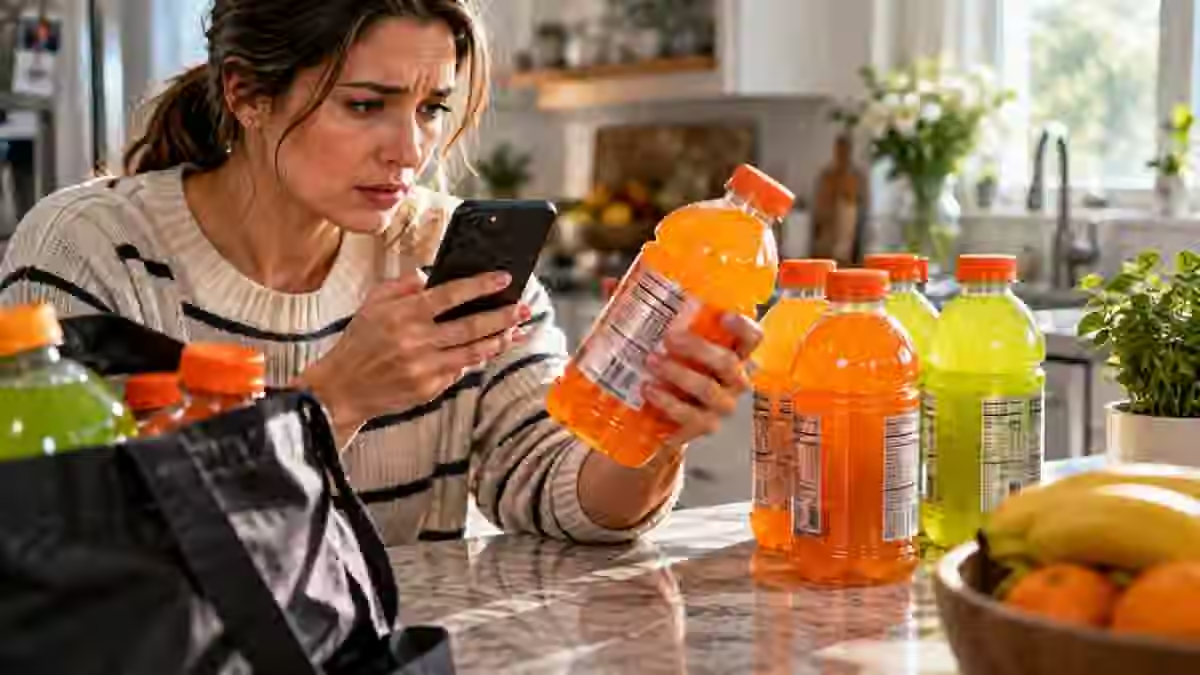
If you have a 28-ounce bottle of Gatorade Lemon Lime, Lemon Lime Zero, Orange or Orange Zero at home, check it before drinking it. PepsiCo has voluntarily recalled 122,021 cases distributed across 37 U.S. states because certain bottles contain Yellow No. 5 and/or Yellow No. 6 that were not declared on the label.
The recall was initiated September 25 and later classified by the U.S. Food and Drug Administration as Class II. That classification means the chance of serious consequences is considered remote, but exposure can cause temporary or medically reversible effects in some people. The issue is not that these colors are universally banned: both are permitted color additives in the United States when used lawfully. The problem is that they must be declared so consumers can make an informed choice, particularly people who know they are sensitive to them.
Which Gatorade products are affected?
The recall covers selected 28-ounce bottles in four varieties: Gatorade Lemon Lime, Gatorade Zero Lemon Lime, Gatorade Orange and Gatorade Zero Orange. Reports based on the FDA enforcement notice say the affected lot dates fall in April, May and June 2027.
Do not assume every bottle of those flavors is recalled. Package size and lot information matter. If you bought a multipack or a different bottle size, check the exact product and date code rather than relying only on flavor.
Why were the drinks recalled?
The labels did not disclose Yellow No. 5 and/or Yellow No. 6 in the affected products. FDA rules require certified color additives to be declared in ingredient labeling. Yellow No. 5 is also known as tartrazine. For most people, this recall is a labeling compliance problem rather than an indication that the beverage is acutely toxic.
For consumers who intentionally avoid synthetic colors, have previously reacted to a color additive or rely on labels for medical reasons, the omission is much more important. A label only works as a safety tool if it accurately describes what is inside.
What does “Class II recall” mean?
FDA recall classifications are often misunderstood. Class II does not mean “second most dangerous bottle” or that everyone who drank the product will become ill. It means use of or exposure to the product may cause temporary or medically reversible adverse health consequences, while the probability of serious adverse consequences is remote.
That is different from a Class I recall, which involves a reasonable probability of serious health consequences or death. It is also different from Class III, where exposure is not likely to cause adverse health consequences.
How many bottles are involved?
The enforcement information cited by major U.S. outlets lists 122,021 cases. Depending on case configuration, that represents well over one million individual bottles. The products were distributed in 37 states, so this is not a local-store recall.
Because distribution is broad, shoppers should check bottles bought from supermarkets, convenience stores, warehouse clubs, gyms, vending suppliers or online sellers rather than assuming a particular retailer was unaffected.
What should you do if you have one?
- Check that the bottle is 28 ounces.
- Confirm the exact flavor: Lemon Lime, Lemon Lime Zero, Orange or Orange Zero.
- Find the lot/date information printed on the bottle.
- Do not drink a bottle that matches the recalled identification if you are uncertain about the undeclared colors.
- Return it to the place of purchase or follow the manufacturer’s consumer guidance.
- If you experienced a concerning reaction, contact a health professional and report the event through the appropriate FDA consumer reporting channel.
What if you already drank it?
Drinking an affected bottle does not automatically mean you will have a reaction. The FDA classification specifically indicates that serious consequences are considered unlikely. If you feel well, there is generally no reason to panic solely because your bottle later appeared in a recall.
If you have a known sensitivity, develop symptoms or are unsure how the recall applies to a medical condition, seek individualized medical advice. Keep the bottle or photograph the lot code if you need to report what you consumed.
Are Yellow 5 and Yellow 6 illegal?
No. FDA’s color-additive database lists FD&C Yellow No. 5 and Yellow No. 6 as permitted color additives for foods when regulatory requirements are met. The central issue here is disclosure. Consumers must be able to see the color additives in the ingredient statement where required.
This distinction matters because social media posts about recalls often compress “undeclared ingredient” into “dangerous banned chemical.” That is not an accurate description of this recall.
How do you check a date code without throwing away the wrong bottle?
Look around the neck, shoulder or lower label area for ink-jet printed production or best-by information. Lighting can make the small code difficult to read, so rotate the bottle and use your phone camera if necessary. Compare the entire code with the recall information, not just the month.
If the code has rubbed off or cannot be read, the practical choice is to contact the retailer or manufacturer before consuming it, especially if the bottle matches the affected size and flavor.
Why does accurate labeling matter even when an ingredient is approved?
Food labels are not merely marketing. They let people avoid allergens, ingredients they react to, dietary exclusions and additives they deliberately choose not to consume. An approved ingredient can still be a problem when the consumer has no way to know it is present.
That is why recalls can occur even when the undisclosed substance is legally permitted in other circumstances. The regulatory failure is that the product as sold does not accurately tell the consumer what it contains.
What not to do
Do not rely on the color of the liquid, a social-media photo or a retailer shelf tag to identify the recall. Do not assume every Gatorade bottle is affected. And do not spread claims that the recall proves all Yellow 5 or Yellow 6 use is illegal in the United States.
Bottom line
This is a large, multi-state recall worth checking, but the fastest way to protect yourself is precise identification rather than alarm. The key filters are 28-ounce bottle, one of four listed flavors, and the affected lot/date information. If your bottle matches, stop using it and follow return or disposal guidance.
Sources
Recall details are based on reporting that cites the FDA enforcement notice, including NBC News. FDA background on food color regulation is available in Color Additives in Foods.
More U.S. consumer alerts are available in Life.