
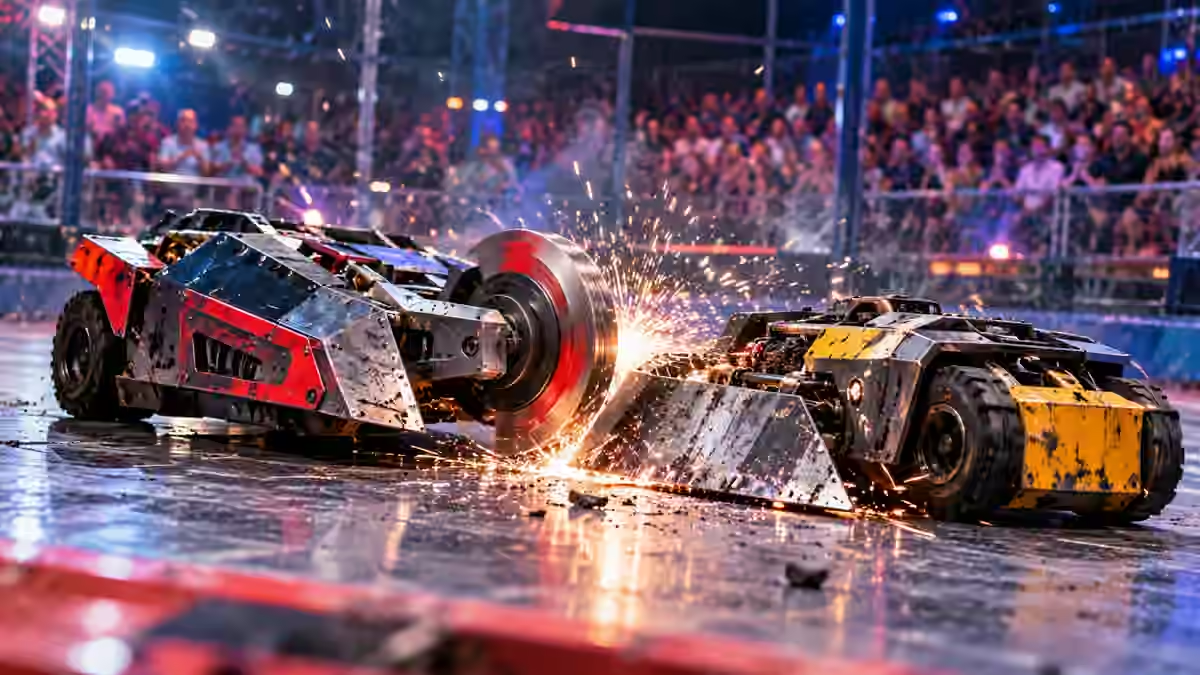
Robo Riots is in Dublin this weekend, 3 and 4 October 2026, bringing 38 robots, four shows and 31 battles to the National Basketball Arena in Tallaght. The event mixes heavyweight combat robotics with engineering, character robots and family entertainment, making it one of the more unusual technology-focused days out in the city.
The spectacle is the obvious draw, but the event is also an accessible way to see real engineering under pressure. Combat robots have to move reliably, absorb impacts, deliver controlled attacks and keep functioning after damage. In a three-minute bout, design decisions that look theoretical on a workbench become very visible to an audience.
When and where is Robo Riots Dublin 2026?
Robo Riots takes place on Saturday 3 October and Sunday 4 October 2026 at the National Basketball Arena, Tymon Park, Tallaght, Dublin 24. The organiser specifically says there is no access via Tymon Lane and advises visitors to follow signs for the National Basketball Arena.
If you already have a ticket, check the date and session time printed on it before travelling. The event runs several shows over the weekend, so arriving for the wrong session could create problems even though the venue is correct.
What will visitors actually see?
The headline attraction is live combat between heavyweight robots. Machines compete in short bouts where driving skill, mechanical design, weapon reliability and damage resistance all matter. The organiser describes a mix of head-to-head matchups, robot rumbles, exhibition fights and established machines associated with the wider Robot Wars scene.
That variety is useful for first-time visitors. Not every battle follows exactly the same pattern. Some robots depend on powerful weapons, others on control, speed, wedges or flipping systems. A machine can look less dramatic but still win by controlling the arena and preventing an opponent from using its weapon effectively.
Why are three-minute battles technically interesting?
Three minutes sounds short, but for a combat robot it can be a demanding endurance test. Motors heat up, batteries discharge under high current, wheels can lose grip, armour can deform and weapon systems can jam. The driver also has to make decisions while the robot may be partially damaged.
This is what makes combat robotics more than a remote-controlled demolition show. Builders have to balance weight, armour, power, manoeuvrability and repairability. Adding more protection may make a robot harder to damage but can reduce speed or leave less weight for a weapon. A stronger weapon can require a bigger battery and tougher frame.
How many robots and battles are scheduled?
The official Robo Riots site lists 38 robots, two days, four shows and 31 battles for the Dublin event. Those numbers give a better sense of scale than a single highlight clip. Visitors are not coming for one isolated demonstration; the programme is built around repeated arena action across the weekend.
Schedules can still change if a machine is damaged or cannot be repaired between fights. That uncertainty is part of live robot competition. A robot that finishes one battle may need substantial work before it can safely return to the arena.
What kinds of robots are involved?
The event includes both combat machines and recognisable character robots. The organiser says previous and featured appearances have included R2-D2, a Dalek, a Minecraft Creeper and AL-1X. The exact mix can vary by show, so visitors should not treat every promotional image as a guarantee that a particular character will appear in every session.
Among the Irish machines associated with the event is Díotóir, a well-known Dublin combat robot. Robo Riots lists it at 110 kg, with a pneumatic flipper, 2 mm Hardox defence, two 750-watt drive motors and a stated top speed of 25 mph. Those specifications show the scale involved: these are substantial machines, not lightweight toys.
Is Robo Riots suitable for children?
The organiser presents Robo Riots as a family event and specifically highlights families, teenagers and technology fans. However, suitability depends on the individual child. Robot combat is loud, fast and visually intense, and the show uses flashing lights.
Families with children who are sensitive to noise should take the organiser’s accessibility note seriously. Ear defenders are recommended for people with noise sensitivity. If flashing lights are a concern, contact the event or venue before travelling so you can make an informed decision for your family.
How loud is the event?
Heavy robots hitting each other inside an arena can produce sudden, sharp noise in addition to amplified commentary and crowd reactions. The official FAQ explicitly warns about loud robot combat and flashing lights.
Ear protection can make the experience more comfortable for children and adults who find sudden noise difficult. It is better to bring suitable hearing protection and not need it than to discover after the show begins that the sound level is uncomfortable.
What can teenagers interested in engineering learn?
Combat robotics connects several disciplines at once: mechanical engineering, electronics, battery systems, radio control, materials, fabrication and software. Even without access to the pits, watching how different machines move and recover from impacts can reveal design priorities.
A useful way to watch is to ask three questions during each fight: how does the robot create an advantage, what part of the machine appears most vulnerable, and how does the driver adapt after something stops working? That turns the spectacle into a practical engineering lesson.
What makes a successful combat robot?
Power alone is not enough. A robot needs traction to transfer motor power to the floor, a strong chassis to keep critical parts aligned after impacts and a layout that protects batteries and electronics. It also needs to be serviceable. Builders often have limited time between fights, so a design that can be repaired quickly has an advantage.
Driver skill matters just as much. A powerful weapon cannot help if the robot is constantly facing the wrong direction. Good drivers manage distance, choose attack angles and avoid exposing vulnerable wheels or sides.
How should visitors plan the trip?
Confirm your exact show time, allow enough time to reach Tallaght and follow venue signage rather than attempting to enter through Tymon Lane. If travelling with children, plan food, toilet and hearing-protection needs before the session starts.
Parking information can change and the organiser advises checking current event information before travel. Public transport users should also allow for Sunday timetables and possible weekend service changes.
Where should tickets be bought?
Robo Riots’ terms state that TicketSource is the sole authorised ticket source. That is particularly important for a popular event weekend, when unofficial resale posts can appear on social media or marketplaces.
If buying late, follow the ticket link from the official Robo Riots website rather than relying on a search ad, forwarded message or screenshot. A valid ticket should correspond to the correct date and show time.
What should you check before leaving home?
- Your ticket date and session time.
- The National Basketball Arena address in Tallaght.
- Current travel or parking information.
- Ear defenders if anyone in your group is sensitive to loud noise.
- Whether flashing lights are suitable for everyone attending.
- The latest event update in case the fight card changes after robot damage or repairs.
Official information
The event timetable, venue, robot count and accessibility warning are published on the official Robo Riots Dublin 2026 website. The official FAQ covers families, noise and the event format, while the ticket terms identify TicketSource as the authorised ticket source.
More Irish technology and practical digital guides are available in Technology.