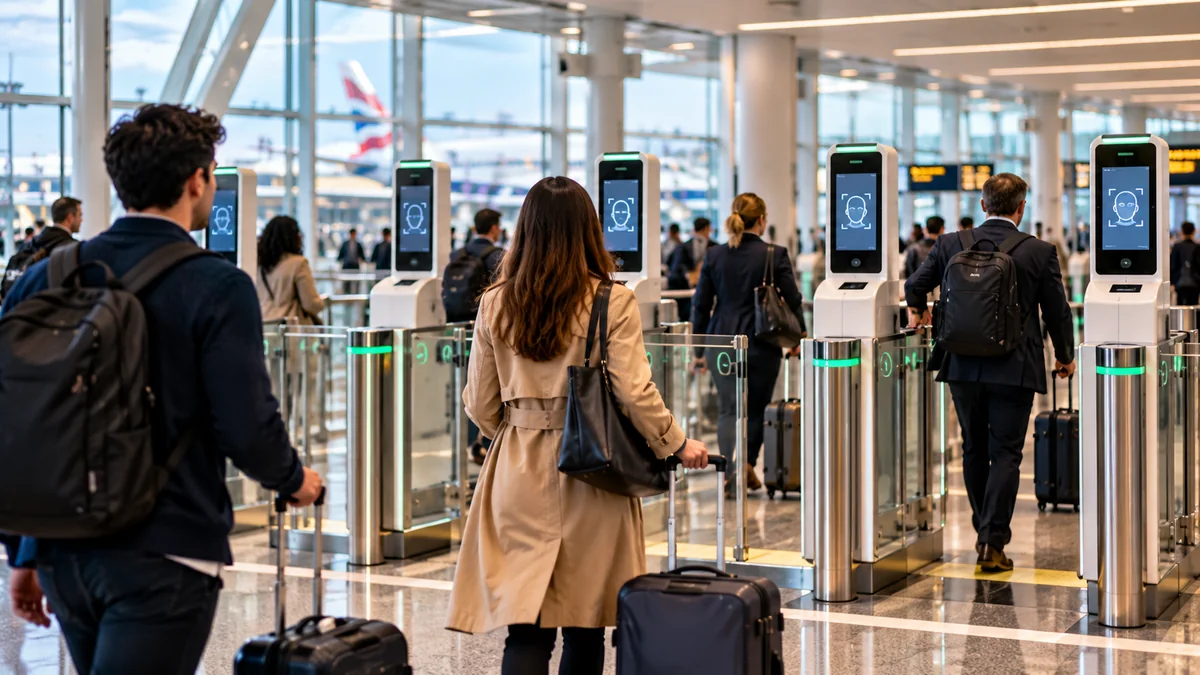
Passengers arriving in the UK will increasingly be able to pass through an airport eGate without placing a passport on the reader. The Home Office began a gradual rollout of new contactless technology on 6 October 2026 and says every eGate is due to be upgraded by early 2027.
The change does not remove immigration checks and it does not mean travellers can leave their passport at home. The gate uses a live facial image and checks it against verified travel, immigration and passport information before opening. The passport is still the travel document that underpins the journey.
What changes at the eGate?
Under the familiar process, a traveller normally places the photo page of the passport on a reader and then looks at a camera. In the new contactless process, the passenger approaches the gate, a live image is captured and the system matches that face against verified information already available to border systems.
If the checks are successful, the gate opens without the traveller physically scanning the passport at that point. The aim is to reduce handling and make the movement through the gate quicker and smoother.
Does “contactless” mean passport-free travel?
No. Travellers still need the correct passport and any other required travel permission. Airlines, ferry operators and border authorities may need to inspect documents at other stages of the journey.
The contactless change applies to how identity is verified at the eGate, not to the legal requirement to hold valid travel documents. Anyone travelling should continue to carry the same passport used for the booking and immigration process.
How does the facial check work?
According to the Home Office, the eGate takes a live image of the passenger and checks it against verified immigration, travel and passport information. This is a biometric identity check: the system is trying to establish that the person standing at the gate is the legitimate holder of the travel identity in the system.
Facial matching is not the only border check. The Home Office says full border security checks continue to be carried out before the gate opens.
When will all UK eGates be upgraded?
The rollout starts gradually from 6 October 2026. The government says every eGate is expected to receive the contactless upgrade by early 2027.
That means travellers should expect a mixed experience during the transition. At one airport or terminal you may use the new process, while another gate may still require the traditional passport scan.
Will queues disappear?
Not necessarily. Faster individual processing can improve flow, but airport queues depend on many factors: how many flights arrive together, how many gates are open, how many passengers are eligible to use them and how often a manual referral is required.
A contactless gate can remove one physical step, but it cannot prevent peak-hour congestion or resolve every identity check automatically.
What happens if the gate does not recognise you?
As with existing eGates, some passengers will be referred to a Border Force officer. This can happen for technical reasons, because a face match is uncertain or because additional checks are required.
Travellers should not assume a failed gate means there is a problem with their immigration status. The practical response is simply to follow staff instructions and have the passport ready.
What about privacy?
Biometric systems inevitably raise privacy questions because a facial image is personal data. The important questions are what information is collected, how it is matched, how long it is retained and who can access it.
The government frames the system as a secure border-verification process rather than an optional airport convenience app. Travellers who want to understand the data rules should consult the Home Office and UK data-protection notices rather than relying on assumptions based on commercial facial-recognition services.
Will children use the new gates?
Eligibility rules for eGates still matter. The contactless technology does not automatically make every passenger eligible. Families should follow the signs and staff instructions at the airport and be prepared for some members of a group to be directed to a staffed desk.
Parents should also keep travel documents accessible even if the gate itself does not require a physical passport scan.
What should travellers do differently?
- Keep your passport with you and easily accessible.
- Use the same travel document linked to your booking and immigration record.
- Remove hats or anything that prevents a clear facial image when requested.
- Follow the eGate screen rather than copying the passenger ahead, because different gates may use different processes during rollout.
- Allow normal connection time; do not assume the new system eliminates border queues.
- If a gate rejects you, follow staff directions instead of repeatedly trying different gates.
Why is the UK making this change?
The government says the goal is a smoother passenger journey while maintaining border security. Airports process very large volumes of arrivals, so even a small reduction in handling time per traveller can matter at scale.
The broader direction is clear: travel identity is becoming more digital and biometric. Airlines already use facial systems in some boarding processes, and governments are increasingly connecting identity data across stages of the journey.
What does this mean for a 2027 trip?
By early 2027, the Home Office expects the upgraded system to be available across the UK eGate network. Travellers should therefore be ready for the contactless process to become the normal experience rather than a pilot.
The best preparation is simple: travel with the correct passport, make sure your details match the booking and follow the gate instructions. “Contactless” should be understood as less document handling at the gate, not less documentation for the journey.
Source
The rollout details and explanation of the live facial check come from the UK Home Office announcement of 6 October 2026, “Airports to go contactless in major boost for UK passengers”.
More UK travel updates are available in Travel.