
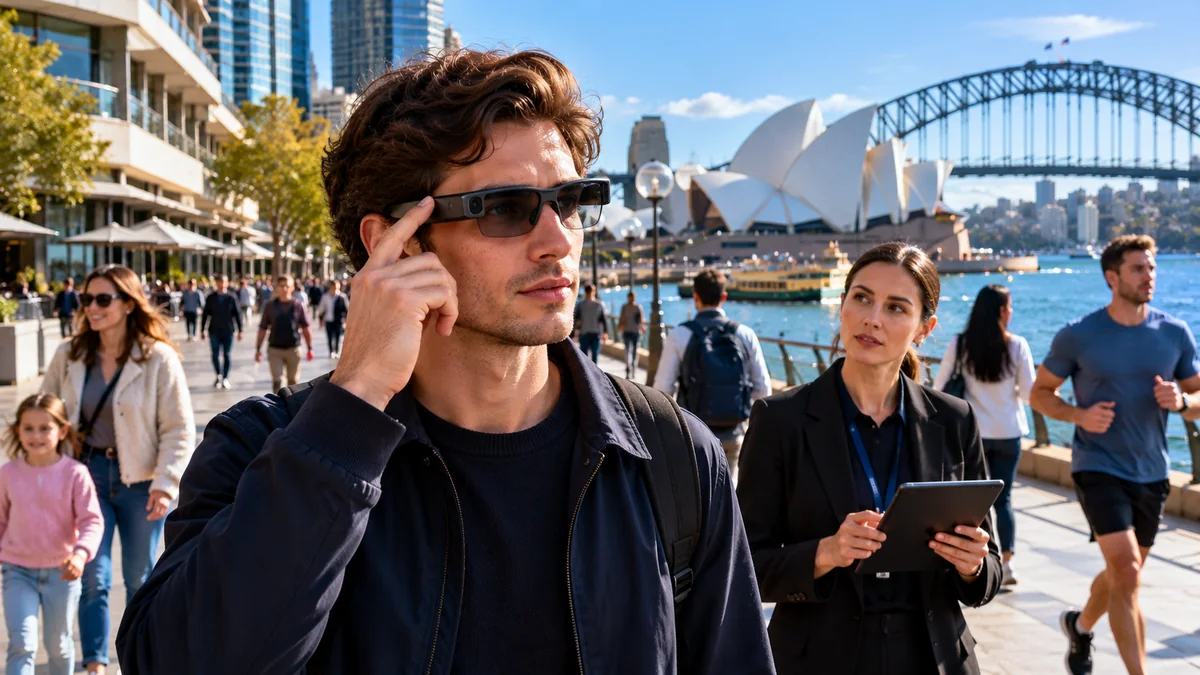
Australia’s privacy regulator is taking a closer look at smart glasses as public concern grows over devices that can record people from a face-level camera. Privacy Commissioner Carly Kind said on 7 October that the Office of the Australian Information Commissioner has made preliminary inquiries with five entities providing smart-glasses hardware or software.
The regulator is trying to understand how and where the Privacy Act applies and how personal information is protected when these products collect images, sound or other data. The issue is becoming more urgent because smart glasses can look similar to ordinary eyewear while carrying cameras, microphones and AI features.
What exactly is the OAIC investigating?
The OAIC says it has approached five providers of smart-glasses hardware or software since August. The preliminary inquiries are intended to clarify how Australian privacy law applies and what protections are being used when personal information is collected.
This is not the same as announcing that all smart glasses are unlawful or that the regulator has found a breach. It is an information-gathering step in an area where product capability is moving faster than everyday expectations about being recorded.
Why are smart glasses different from a phone camera?
A phone is usually visible when someone raises it to take a photo or video. Smart glasses place the camera close to the wearer’s eyes and can make recording much less obvious to people nearby.
That matters in places where people reasonably expect more privacy: swimming pools, gyms, playgrounds, workplaces, medical settings and changing areas. A small indicator light may not be noticed, especially at a distance.
What has changed since August?
The Privacy Commissioner says community concern has increased. She points to local-government bans in sensitive public spaces, a petition against certain brands that has attracted more than 55,000 signatures and a proposal to restrict smart glasses in federal workplaces and public-service offices.
These developments do not create one national ban, but they show that organisations are starting to write their own rules rather than waiting for a single technology-specific law.
Does the Privacy Act cover an individual wearing smart glasses?
The answer can depend on who is collecting the information and in what context. Australian privacy law applies differently to organisations and to purely personal or household activities. That is one reason the legal picture is not as simple as “camera equals illegal”.
For businesses, employers and service providers, the obligations can be more significant because they may be collecting and processing personal information as part of commercial operations.
What information can smart glasses collect?
Depending on the model, smart glasses can capture photos, video and audio. Some products connect those recordings to AI services that can describe surroundings, answer questions, translate text or identify objects.
The privacy issue therefore extends beyond the first recording. Users should ask whether data is processed on the device or sent to a server, whether it is stored, how long it remains available and whether it is used to improve AI systems.
Why does facial technology raise extra questions?
A normal street photo contains faces, but a system capable of analysing or matching faces can transform an image into more sensitive identity information. That increases the potential consequences of collection.
Even when a product does not identify strangers by name, continuous recording combined with location, audio and cloud processing can reveal patterns about people who never chose to use the device.
What should smart-glasses owners do now?
- Learn what the recording indicator looks like and keep it unobstructed.
- Tell people when you are intentionally recording them.
- Avoid recording in places with a strong expectation of privacy.
- Check whether photos, video, audio or AI requests are stored in the cloud.
- Review automatic upload and sharing settings.
- Respect venue rules even when the device itself is legal to own.
What should businesses and venues do?
Organisations should decide whether their existing photography and recording policies are clear enough to cover wearable devices. A rule written around “phones and cameras” may be ambiguous when the camera is built into glasses.
Clear signage is especially important in gyms, pools, childcare environments, clinics and workplaces. Staff also need a consistent procedure for asking a visitor to stop recording or remove the device.
Can a visible recording light solve the problem?
It helps, but it is not a complete solution. A light only works as a privacy signal if people know what it means and can see it. In bright sunlight, crowded spaces or fast-moving situations, that may not be enough.
Product design can reduce risk through hardware indicators, physical camera switches, local processing and controls that make continuous or covert recording difficult. Regulation and responsible use still matter.
Are smart glasses being banned in Australia?
There is no single nationwide ban described by the OAIC. Instead, some local governments and organisations have introduced restrictions in specific sensitive locations, while broader policy proposals are being debated.
Owners should therefore check the rules of the place they are entering. A product can be legal to possess while still being prohibited in a particular venue.
What happens next?
The OAIC’s preliminary inquiries could help clarify which entities have obligations under the Privacy Act and what good privacy practice should look like for this category. The regulator may also use the information to guide future policy, enforcement or public advice.
For consumers, the practical shift is already happening: smart glasses are moving from novelty gadget to everyday privacy question. The more discreet the technology becomes, the more important transparent recording behaviour and clear venue rules become.
Source
This article is based on Privacy Commissioner Carly Kind’s 7 October 2026 OAIC blog post, “Smart glasses under the microscope”.
More Australian digital-policy coverage is available in Technology.