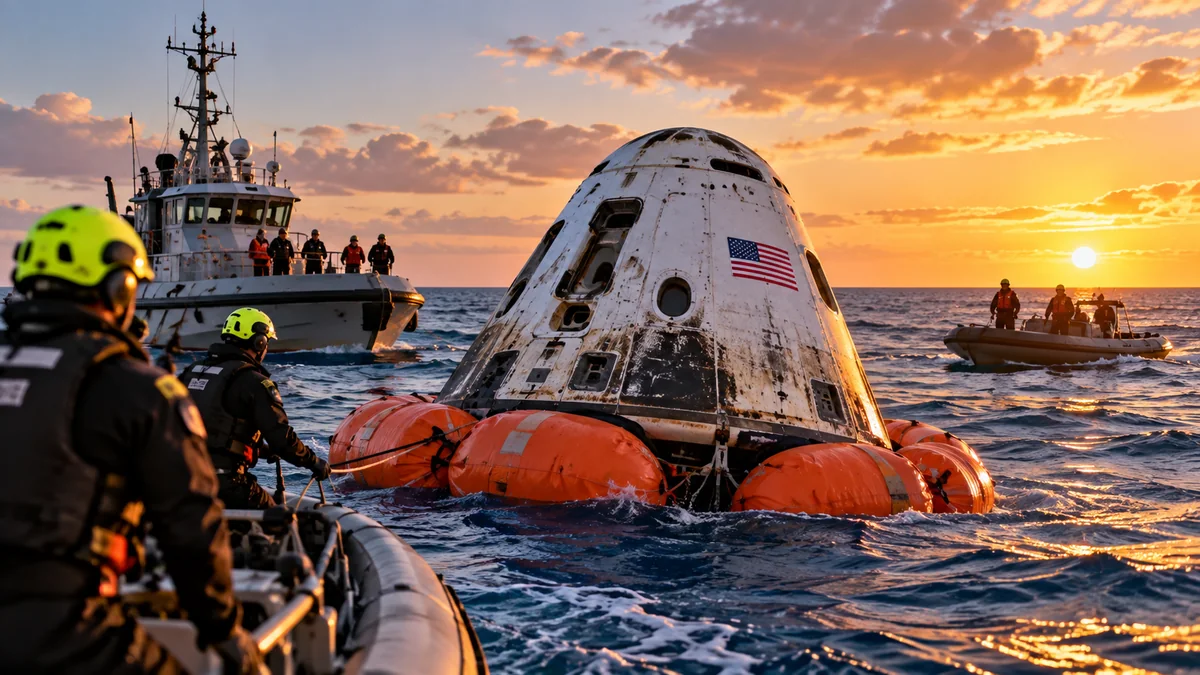
NASA and SpaceX are targeting Wednesday, October 7, for Crew-12 to undock from the International Space Station, followed by a splashdown off the California coast on Thursday, October 8. The schedule is weather-dependent, but NASA has now published a detailed return timeline for the four-person crew after nearly eight months in orbit.
The mission brings home NASA astronauts Jessica Meir and Jack Hathaway, ESA astronaut Sophie Adenot and Roscosmos cosmonaut Andrey Fedyaev. The four launched to the station in February and are now preparing Dragon for the final phase of the mission after handing station responsibilities to the incoming crew.
When is Crew-12 scheduled to leave the ISS?
NASA's current plan calls for hatch-closing coverage to begin at 6 a.m. Eastern on Wednesday, October 7, with hatch closure targeted for about 6:20 a.m. Undocking coverage is scheduled to begin at 7:45 a.m., followed by undocking at about 8:05 a.m. Eastern.
Those times are targets rather than guarantees. Mission managers can move them if weather, recovery conditions, spacecraft readiness or station operations require a change. NASA and SpaceX continue to monitor the Pacific recovery area before committing the crew to departure.
When is splashdown?
If Dragon leaves on the current schedule, NASA expects return coverage to begin at 10:20 a.m. Eastern on Thursday, October 8. The deorbit burn is targeted for 10:46 a.m., with splashdown at approximately 11:34 a.m. off the coast of California.
The exact landing location is selected from approved recovery areas based on sea state, winds, visibility, lightning risk and the ability of recovery teams to operate safely. That is why a precise coastal location may not be locked in far in advance.
Why does Dragon spend more than a day between undocking and splashdown?
Leaving the station is not the same as immediately dropping toward Earth. After undocking, Dragon performs a sequence of departure and phasing maneuvers to move safely away from the ISS and line up its orbit for return. The timing also gives mission teams flexibility to reach an appropriate splashdown opportunity.
Before re-entry, the spacecraft performs a deorbit burn that lowers its orbit and commits it to atmospheric entry. The trunk section is separated, the capsule encounters intense heating during re-entry and parachutes then slow Dragon before it reaches the Pacific.
Who is returning on Crew-12?
- Jessica Meir, NASA astronaut and Crew-12 commander.
- Jack Hathaway, NASA astronaut and Crew-12 pilot.
- Sophie Adenot, European Space Agency astronaut and mission specialist.
- Andrey Fedyaev, Roscosmos cosmonaut and mission specialist.
The crew supported Expedition 74 and 75 work aboard the station, including research, maintenance and preparation for future missions. NASA says their stay included studies relevant to human health on Earth and to longer-duration exploration beyond low Earth orbit.
Why can weather delay a space station departure?
Dragon lands in the ocean, so the return team needs acceptable conditions not only in the atmosphere but at sea. Strong winds or rough waves can complicate the capsule's landing and the work of recovery boats and helicopters.
NASA and SpaceX review a primary and alternate supported landing site before departure. They monitor wind, wave conditions, rain, lightning, cloud ceilings and visibility. If conditions do not meet operational limits, managers can delay undocking rather than send the crew into a return timeline with no suitable recovery option.
What happens immediately after splashdown?
Recovery teams approach Dragon in fast boats, check the capsule and the surrounding area, and prepare it to be lifted onto the main recovery vessel. Once Dragon is secured, crews open the hatch and help the astronauts out for initial medical checks.
Returning from months in microgravity can make standing and walking difficult. The crew has to readapt to Earth's gravity, so medical teams monitor them closely after recovery.
Where can you watch the return?
NASA says it will stream the major milestones through its live platforms. The agency plans live coverage for hatch closure and undocking on October 7, then live deorbit and splashdown coverage on October 8.
Viewers should check NASA's live schedule shortly before each event because spaceflight timelines can shift. A weather hold or operational change can move the start of coverage as well as the underlying mission milestone.
What changed after Crew-13 arrived?
Crew-13 arrived at the station on October 1, allowing a handover period before Crew-12's departure. During a crew rotation, incoming astronauts learn the current state of station systems, experiments and daily operations from the outgoing crew rather than simply replacing them at the docking port.
Jessica Meir also transferred command of the station to Roscosmos cosmonaut Pyotr Dubrov during the change-of-command process. That lets Expedition 75 continue while Crew-12 prepares Dragon for home.
Why the California coast matters
NASA and SpaceX now use designated recovery sites off California for Dragon crew returns. The recovery system includes maritime safety zones, dedicated recovery vessels, medical teams and coordination with federal agencies.
A water landing allows the capsule to use parachutes and a relatively simple recovery architecture, but it also makes sea conditions a major part of the go/no-go decision. A calm ocean can be just as important to the return plan as clear skies.
What to watch next
The most important update will be NASA's final weather and recovery review before undocking. If conditions remain acceptable, Crew-12 will close the hatch Wednesday morning, separate from the station and begin its trip home. If not, the station and Dragon can support a later departure opportunity.
After Crew-12 leaves, station operations continue with Expedition 75, while another SpaceX Dragon mission is scheduled to deliver cargo and science to the orbital laboratory.
Sources
NASA published the current timeline on October 5 in “NASA to Stream SpaceX Crew-12 Return, Splashdown Live”. NASA's station blog also details the Crew-13 handover and Crew-12 departure preparations.
More U.S. technology and space coverage is available in Technology.