
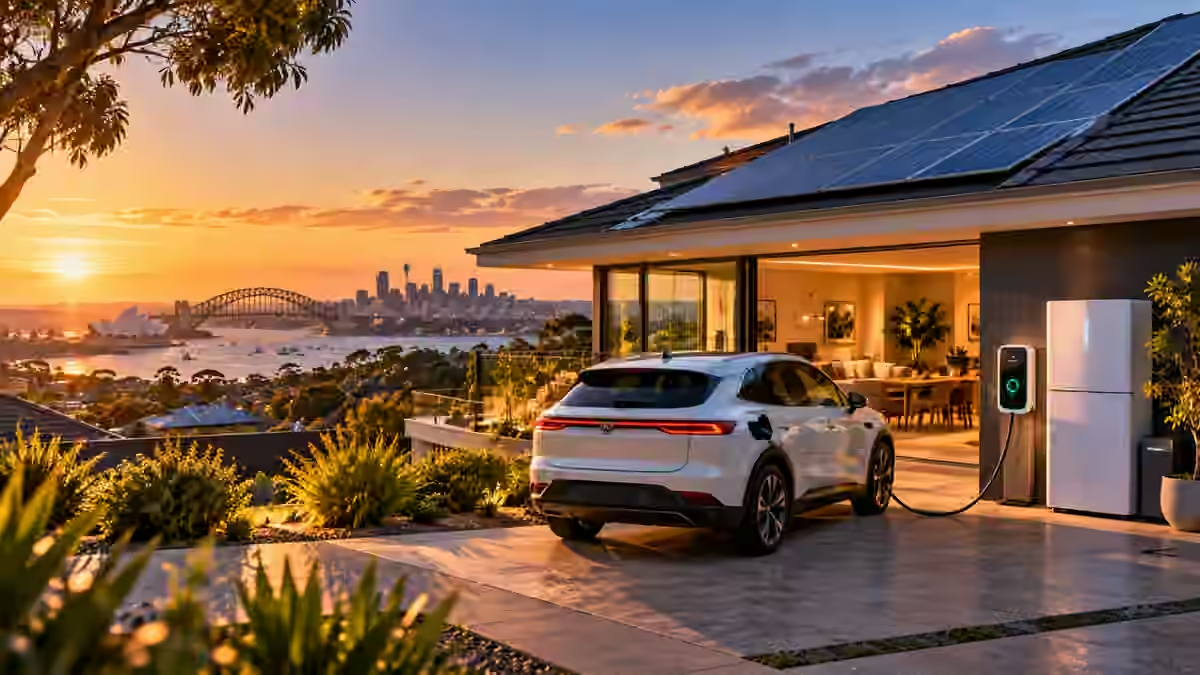
Australia’s future home may contain an electric car, a home battery, smarter appliances and software that shifts energy use to cheaper or cleaner periods, but technology alone will not determine whether households embrace that future. New Monash University research argues that trust, control, safety, care, inclusivity and uncertainty are likely to shape how Australians adopt and use emerging household energy systems.
The report, Foresights for Future Australian Home Life, is useful because it moves beyond a simple “more smart devices equals a smarter home” story. A household can see value in automation while still worrying about cybersecurity, data use, affordability or losing control over essential services. The transition therefore depends on how technology fits real routines, not only on what the hardware can technically do.
What did the Monash researchers study?
The Emerging Technologies Research Lab examined how Australians may live with changing energy and digital systems. The work included ethnographic research with 42 households across six states and territories, representing different housing, income and geographic situations. Monash says around half were more exposed to adverse changes because of circumstances such as low income, renting, apartment living, disability, energy hardship or climate-related risks.
The qualitative work was supported by a nationally representative survey of more than 5,000 Australians conducted in 2025, as well as industry research. That combination is important: household visits provide detail about how people actually make decisions, while the survey gives broader context.
The six values behind the future home
The researchers identify six “foresighting values”: trust, control, safety, care, inclusivity and uncertainty. They are not a list of gadgets. They are lenses for understanding why two households offered the same technology may respond differently.
A home battery, for example, may appeal because it can store rooftop solar and provide resilience. But adoption can slow if the household does not trust the provider, cannot afford the upfront cost, rents the property or worries that a connected system could be remotely controlled in ways it does not understand.
Why trust matters more as homes become connected
Energy devices are increasingly digital. Smart meters, batteries, EV chargers, thermostats and appliances can collect data or connect to external services. That creates new benefits, including automation and demand management, but it also makes cybersecurity and data governance part of the household energy decision.
Monash links these concerns to a broader environment in which Australians are more conscious of breaches and AI-related risks. The practical lesson for manufacturers and energy providers is clear: a product can be technically efficient and still fail if people do not trust how it handles their data or what happens when the cloud service goes down.
What could home batteries change?
A battery can shift electricity use from one time of day to another. For a solar household, that can mean storing daytime generation and using it after sunset. In a more dynamic electricity market, batteries may also respond to tariffs or grid signals.
The future question is not only battery capacity. Households will want to know who controls charging and discharging, whether automation can be overridden, what happens during an outage and how financial benefits are calculated. A system that saves money but feels opaque may struggle to earn trust.
How do EVs become part of the house?
An electric vehicle changes the home’s energy profile because charging can become one of its largest flexible loads. For households with off-street parking, a car may be charged overnight, during solar production or when prices are lower. Future vehicle-to-grid systems could potentially allow compatible cars to send power back to a home or network.
But the research highlights why the transition is uneven. Renters, apartment residents and people without reliable home charging face different barriers from homeowners with garages and rooftop solar. A national EV transition cannot assume every household has the same physical or financial starting point.
Why control is a design requirement
Automation can reduce effort. A smart system might delay a dishwasher, adjust an air conditioner or schedule EV charging without the resident manually checking prices. Yet people may resist if automation makes decisions that conflict with family routines.
The strongest design is therefore likely to combine useful defaults with understandable controls. A household should be able to see what the system is doing, why it is doing it and how to override it. “Smart” should not mean inscrutable.
What does safety mean in an electrified home?
Safety has several layers. There is physical safety around batteries, chargers and electrical equipment. There is cyber safety when devices are connected. There is also resilience: whether a household can keep essential services operating through extreme weather or an outage.
Australia’s climate makes the resilience question particularly important. Heating and cooling can become essential during heatwaves or cold events. A future energy system that is efficient in normal conditions but fails vulnerable households during extremes would not meet the broader social definition of safety used in the report.
Working from home changes electricity demand
Hybrid work has made the home a workplace for many Australians. That shifts some energy use from offices to houses and apartments. Daytime cooling, heating, computers, monitors, networking equipment and cooking may all increase when someone is home for more hours.
For energy planners, the change is not just total consumption. Timing matters. A household with rooftop solar may be able to use more of its own generation during the day, while an apartment resident without solar could experience higher daytime bills. The same work trend therefore produces different outcomes.
Why inclusion can decide whether the transition works
Many clean-energy technologies reward households that can make large upfront investments. Owners can install solar, batteries and chargers; renters often cannot. Higher-income households may be able to buy a new EV or efficient heat pump while financially stressed households keep older appliances longer.
That creates a policy challenge. If tariffs and systems increasingly assume flexible smart devices, households without those devices could miss savings or face higher exposure to peak prices. Inclusion means designing programs that work for renters, apartments, people with disabilities and households under financial pressure.
What does “care” mean in an energy system?
Household decisions are rarely based only on individual optimisation. People use energy to care for children, older relatives, pets and themselves. They may prioritise comfort or medical needs over a price signal, and that is rational from the household’s perspective.
A future energy service that ignores these priorities could frustrate users. Better systems should recognise that some loads are flexible while others are not. An EV may be able to wait two hours to charge; a medical device or necessary cooling during extreme heat cannot.
Where does AI fit?
AI could help forecast household demand, optimise batteries, interpret tariffs or coordinate multiple devices. It could also make systems harder to understand if decisions are hidden behind algorithms. The value of AI will therefore depend on transparency and reliability as much as prediction quality.
For consumers, useful questions include: what data does the system collect, is information processed locally or in the cloud, what happens without internet access, can automated decisions be overridden and how are software updates secured?
What should households consider before buying smart-energy technology?
- Whether the product still performs essential functions if internet access fails.
- How long software and security updates are promised.
- Who receives household or energy-use data.
- Whether automation can be understood and overridden.
- Total ownership cost, not just the purchase price.
- Compatibility with solar, batteries, EV chargers and future tariffs.
- Whether the technology suits renters, apartments or shared buildings.
What the report does not claim
The six values are not a forecast that every Australian home will install the same package of batteries, EVs and AI appliances. Monash explicitly frames them as tools for scenario development and understanding the conditions under which people may adopt, adapt or reject technologies.
That distinction matters. The future home will not be one universal design. A detached solar household in regional Australia, an inner-city apartment and a rental property can all participate in the energy transition in different ways.
Official research
Monash University summarises the findings in its 30 September research release. The project page for Foresights for Future Australian Home Life explains the six themes, evidence base and intended use in modelling, policy and product design.
More Australian housing, technology and design coverage is available in Home & design.